
Some children walk as early as 10 months, while others wait until 18 months without showing any developmental abnormalities. Official recommendations place independent walking between 12 and 18 months, but there is significant variability from one child to another. There is no scientific consensus linking the timing of first steps to future intellectual ability.
Factors such as genetics, muscle tone, or family environment influence each baby’s motor timeline. Identifying a true delay requires careful observation of other motor and social skills, well beyond just the date of walking.
The Major Milestones of Learning to Walk in Babies
Learning to walk is not limited to a sudden act: it is a journey marked by stages that tell the story of a developing body. Between 8.5 and 20 months, each child carves their own path, dictated by their internal dynamics and the incredible flexibility of human development. Behind the diversity of ages, there is neither advancement nor intellectual delay, simply the mark of a unique journey.
Let’s take a closer look at what the child goes through: they start by rolling over, explore the world by crawling, and then discover stability while sitting. When standing becomes possible through effort and balance, the first wobbly steps are not far behind. Each phase requires coordination, muscle strength, and spatial awareness, all building blocks for independence.
Here are the main components of these motor advancements:
- Gross motor skills: postural control strengthens, from mobility on all fours to standing.
- Fine motor skills: the hand grasps, the eye guides, each movement refines balance.
- Sensory adaptation: the child adjusts their movements to the environment, learning to respond to external stimuli.
Walking is a key milestone, but it is only the most visible part of a learning process where the brain, muscles, and surroundings interact tirelessly. Despite discussions around the link between late walking and intelligence, science remains clear: there is no solid evidence to support this idea. What matters is the overall progression of the child, not the exact date of their first steps.
Late Walking: Should You Worry About Your Child’s Development or Intelligence?
The moment a baby takes their first steps often holds a special, almost mythical place in the lives of parents. However, seeing a child walk after 15 or 18 months should not raise alarms about their intellectual abilities. Research conducted by Oskar Jenni in Zurich and Valentin Rousson in Lausanne is unequivocal: there is no link between the age of walking and IQ, nor even future academic performance. More than a thousand children followed over the years confirm this: it is not the timing of walking that shapes cognitive future.
It is common for parents to wonder, sometimes worry, when walking takes longer to develop. But in most cases, this difference simply reflects human diversity and the subtle interplay between heredity, environment, and maturity. If walking has not occurred by 18-20 months, it is best to seek the advice of a pediatrician. However, most of the time, no pathology is involved, unless other concerning signals are detected.
To understand what influences motor development, several points deserve attention:
- Motor development results from the joint action of genetic, familial, and emotional factors.
- Affective state, the richness of sensory experiences, and the quality of interactions shape the pace of acquisitions.
- What matters is the continuity of progress: stable sitting, moving to standing, and then acquiring independent walking.
Walking reflects only one facet of development. Behind this milestone, a whole cognitive world is being built: thinking, discovery, awareness, all areas flourishing, regardless of the date of first steps.
Factors Influencing Motor Pace and Signs to Watch For
The learning to walk process cannot be explained by a simple equation, but by a mosaic of influences. Research estimates that genetic factors account for about a quarter of the variation in motor timelines. The rest? It plays out in the family environment, daily stimulation, the freedom of movement offered to the child, and the practice of free motor skills, all levers to enhance confidence and coordination.
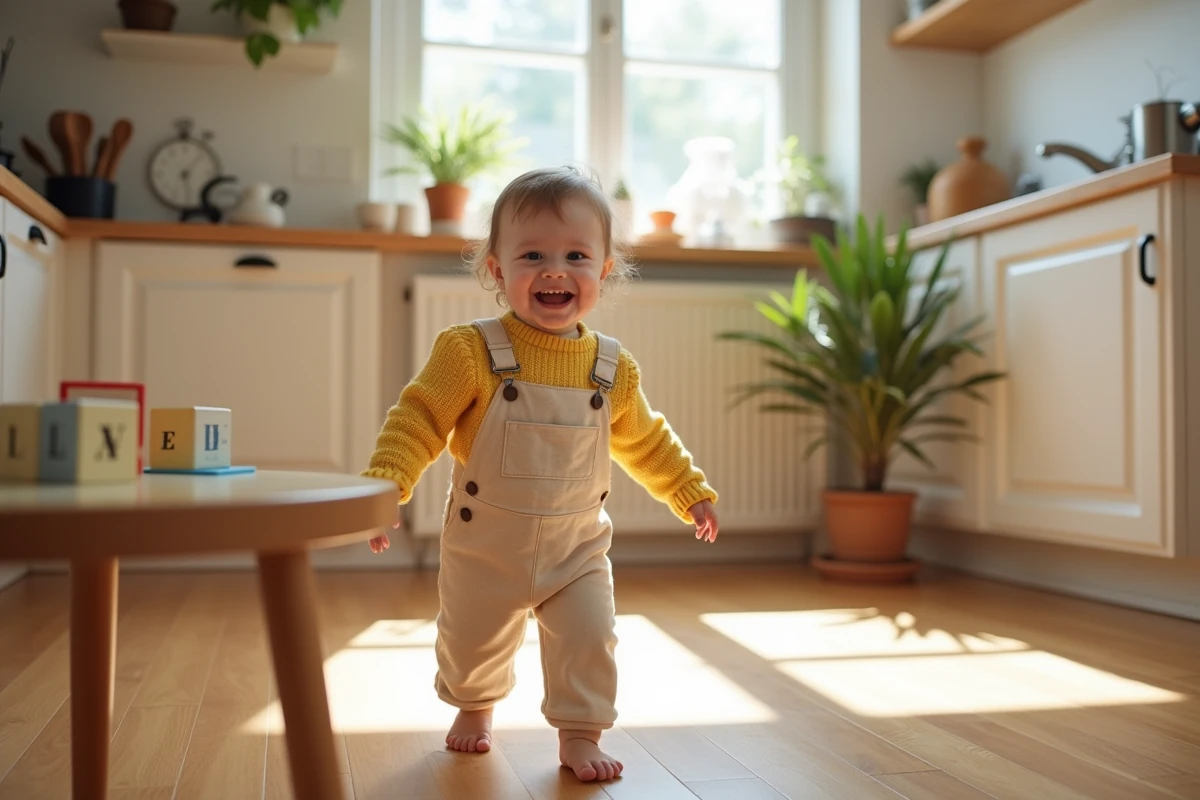
Some everyday objects, such as walkers, can sometimes hinder walking by limiting autonomy and body awareness. Rigid shoes, on the other hand, restrict joint freedom. Encouraging barefoot moments or using non-slip socks can stimulate exploration and muscle strengthening.
Several elements influence and modulate the child’s progression:
- Affective and psychological factors: attachment, emotional security foster the desire to explore.
- Prematurity can slow down walking, without prejudging overall development.
- Some medical conditions (neurological, orthopedic) can sometimes explain a delay, but are most often accompanied by other warning signals.
The question truly arises if the child does not achieve other motor milestones: difficulty sitting up after 10 months, absence of crawling, low muscle tone. In these situations, a specialized opinion is necessary. But for most, the motor pace follows its own logic, without adhering to a universal timeline.