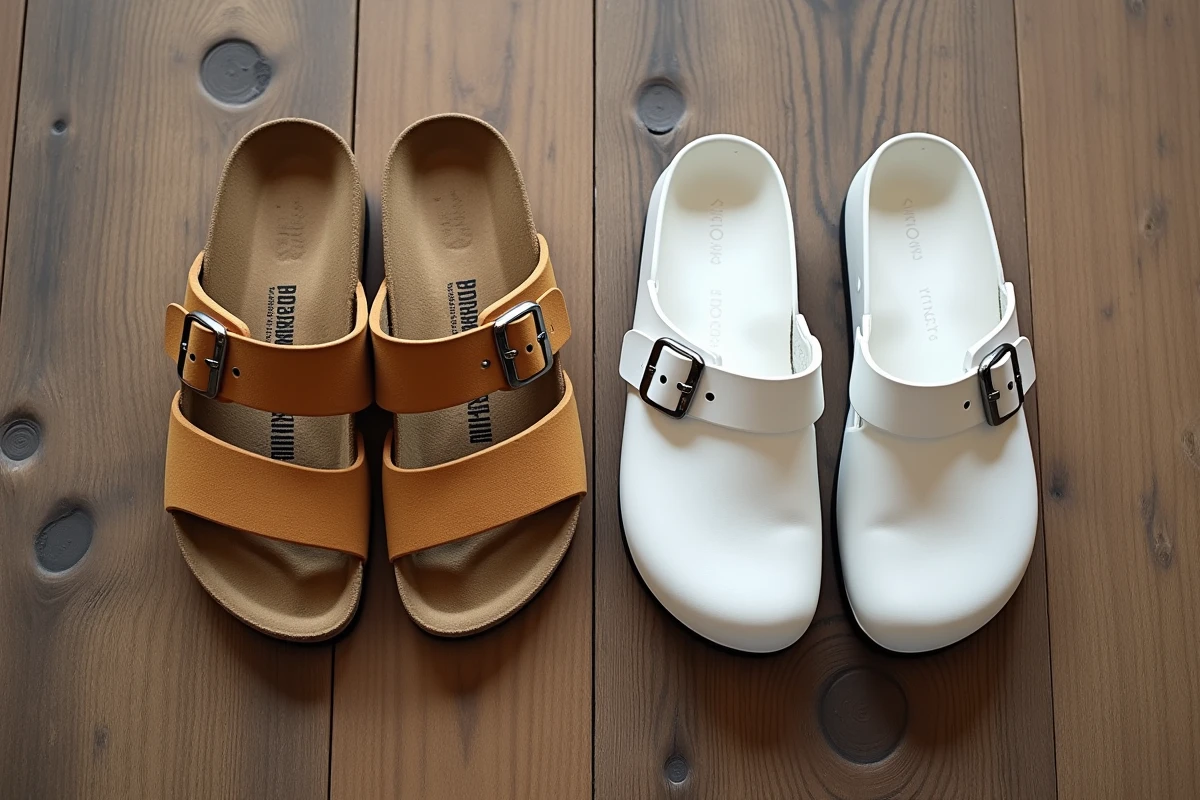
We walk ten hours a day at a trade show, we go back and forth in the city with a loaded bag, or we simply look for a reliable pair for the weekend. In these situations, two brands consistently come up in conversations: Birkenstock and Scholl. Their anatomical soles look similar at first glance, but the choice between the two depends on very concrete constraints that we will detail here.
Birkenstock vs Scholl anatomical sole: what changes underfoot
When you slip on a Birkenstock for the first time, the sensation is quite unique. The cork and latex sole gradually molds to the foot, with a break-in period that can last several days. The arch support is pronounced, almost rigid at first, which can be surprising if you are coming from soft shoes.
With Scholl, the approach is different. The brand, born in a medical context thanks to podiatrist William Mathias Scholl, offers soles that are often softer from the first use. The comfort is immediate, but the support evolves less over time. You don’t have that gradual molding that Birkenstock cork offers after a few weeks.
In practice, for someone who needs firm support over time (prolonged standing, daily walking in an urban environment), the Birkenstock sole holds up better. For more occasional use or if you struggle with the break-in phase, Scholl allows you to be comfortable from day one. We were able to consult the Birkenstock vs Scholl comparison that details these differences in feel, sole by sole.

Birkenstock premium and Scholl versatile: two pricing strategies to understand
Birkenstock has clearly chosen a high-end positioning in recent years. The German brand is multiplying fashion collaborations and strengthening its presence in selective distribution channels. The price reflects this: a pair of Birkenstocks costs significantly more than a comparable Scholl model.
Scholl, on the other hand, has repositioned itself towards everyday well-being and versatility. The communication no longer relies solely on the orthopedic argument but on the idea of a shoe suitable for all moments of the day. The result is a wider range in terms of price, with accessible entry-level models.
What the price really reflects
The price gap between the two brands is not only explained by marketing. Birkenstock uses natural cork, tanned leather from its own workshops, and assembles in Europe. Birkenstock materials are designed to last several years with minimal maintenance.
Scholl offers varied materials depending on the ranges, from synthetic to leather, with durability that largely depends on the chosen model. For entry-level models, feedback varies on this point: some users report faster wear of the insole.
Size and width: the trap that both brands manage differently
A recurring thread on forums concerns the size discrepancy with Birkenstock. The brand uses its own sizing system, often shifted from European standards. In practice, you often order one size up from your usual size, and you must choose between two widths (regular and narrow).
- With Birkenstock, measuring your foot in centimeters and relying on the official size guide rather than your usual size avoids most errors
- With Scholl, the sizing system follows the classic European standard, which simplifies online ordering
- For wide feet, Birkenstock in regular width offers a volume that few competing brands provide
This technical detail has a direct impact on returns in e-commerce. If you order without trying, the risk of size error is significantly higher with Birkenstock than with Scholl.
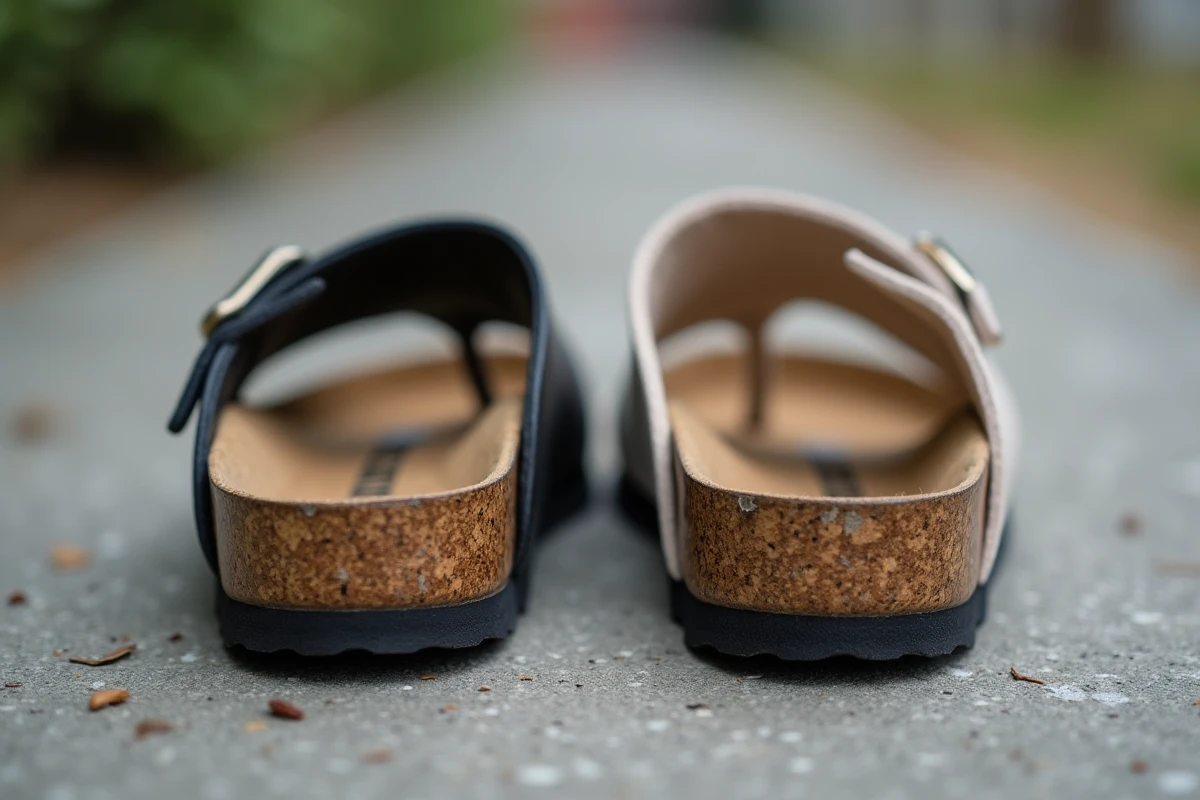
Comfort sandals in the city: which model for what daily use
The comfort sandal market has shifted in recent years. We no longer talk about a shoe confined to the beach or home. Anatomical sole models are now worn as real city shoes, at the office as well as on the terrace.
Birkenstock has capitalized on this trend with models like the Arizona or the Boston, which have become references in both fashion and comfort. The brand embraces a recognizable, almost identity-driven style. Wearing Birkenstocks in the city is no longer a fallback choice.
Scholl for mixed days
Scholl targets a less polarizing register. Its recent models aim to blend into a classic wardrobe without displaying such a strong brand DNA. For someone who wants anatomical comfort without the “statement” fashion aspect, Scholl offers a discretion that Birkenstock no longer seeks.
In practical terms, for a day that alternates between walking, commuting, and office work, Scholl often offers a more visually neutral compromise. For outings where style matters as much as comfort, Birkenstock has the advantage.
Birkenstock or Scholl: the criteria that decide based on your situation
- Prolonged standing or intensive walking: Birkenstock, thanks to the support of the cork that molds to the foot over time
- First pair of anatomical sandals without an adaptation period: Scholl, for immediate comfort
- Tight budget with a need for versatility: Scholl, whose entry-level remains more accessible
- Investment for several seasons with daily use: Birkenstock, whose material durability justifies the extra cost
The choice between these two brands is not just a matter of overall quality. Birkenstock and Scholl meet different expectations, and the best pair is the one that fits the reality of your days, not a brand reputation.